
Closing the Books on a Mining Day
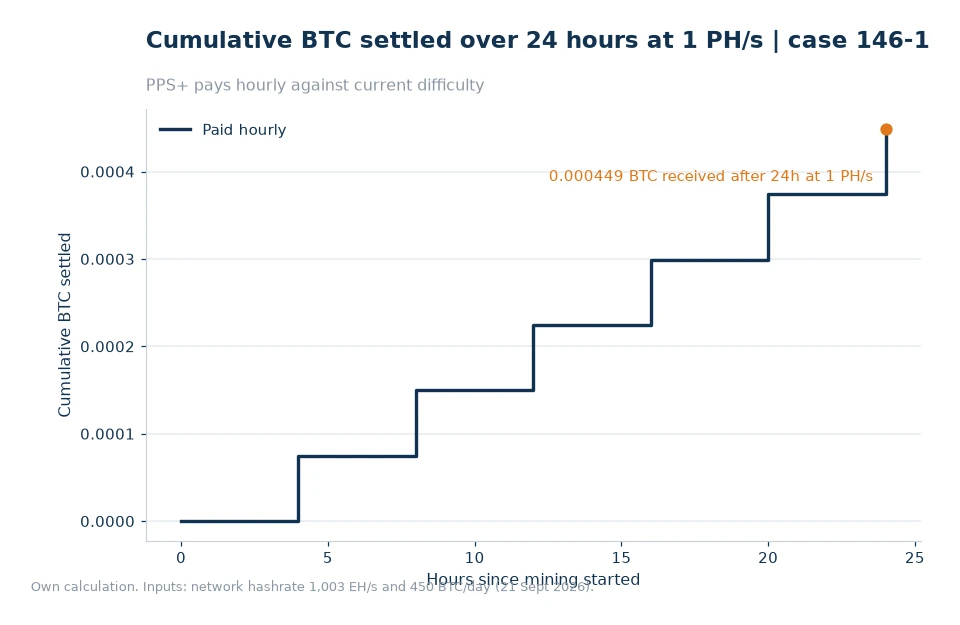
Monthly mining reports flatter almost everyone, because a good week and a bad week cancel and the result looks like a trend. A daily close is harder to fake. One day at 1 PH/s credits 0.00044861 BTC, worth $37.99 at $84,692 per BTC, and against that figure sit power, cooling and any hosting fee. If the net is thin, the daily sheet says so while there is still time to act.
Key takeaways
- A petahash credits 0.00044861 BTC a day, or $37.99 at the 21 Sept 2026 price.
- At 20 J/TH and $0.06/kWh, a petahash burns 480 kWh a day and $28.80 of power.
- Closing daily turns a monthly surprise into a two-day conversation with the host or the utility.
- Record BTC kept, not BTC credited; the two differ by every cost line on the sheet.
Why a day is the right accounting period
Mining settles hourly and reports continuously, so a day is a natural close: 24 credits, one power meter read, one cooling estimate. It is also short enough that the person closing the books can remember what happened. If the site was down for an hour, the daily sheet can say which hour. A monthly sheet cannot, and by the time it is produced the incident is a rumour.
Daily closing has a second benefit that is easy to underestimate. It forces the cost side to be measured at the same frequency as the revenue side, and cost is where mining operations usually lose money without noticing. A power contract with a demand charge, a cooling plant running harder in summer, a hosting invoice with a fixed monthly component: none of these show up cleanly in a monthly revenue figure, but all of them show up in a daily comparison against a baseline.
Three lines and a subtraction
The sheet needs a gross credit, a power cost and a cooling allowance. Everything else, including hosting fees and repairs, can be added as a memo line until it becomes large enough to deserve its own row. Keeping the core to three lines means the close takes five minutes and therefore actually happens on a busy day.
Gross credit comes from the account, not from a forecast. Power comes from the meter, or from a rated draw multiplied by hours if the site has no sub-metering. Cooling can be estimated as a percentage of power, typically somewhere between five and fifteen percent depending on climate and plant design; the exact figure matters less than using the same figure every day so that the trend is comparable. Sites that host third-party machines appear under ViaBTC Mining Farms, and the fee schedule supplies the listed rates that belong on the memo line, so the sheet and the contract quote the same numbers.
Set a tolerance band for each line before the first close, and write it at the top of the sheet. Two percent on power, three percent on the credit, one percentage point on the cooling share: anything inside the band is a normal day and needs no explanation. Anything outside gets a sentence. The band is what stops the exercise from turning into a daily argument with yourself about whether $6.31 is a good number, which is not a question a single day can answer.
Keep the arithmetic visible in the sheet rather than only the result. If the power line is 480 kWh times a tariff, write both numbers. Six months later, when the tariff has changed twice and the machines have been swapped, the old rows will still be auditable. A spreadsheet that stores only totals becomes a set of unexplained numbers, and unexplained numbers are the first thing to be abandoned when a month gets busy.
What the daily close usually reveals
Most days reveal nothing, which is the point. The value arrives on the days when something is off by a few percent and the sheet makes the deviation visible before it compounds. A cooling allowance that creeps from ten to fourteen percent over three weeks is a filter loading up or a fan losing efficiency. A power line that jumps on a mild day is a machine that has changed its power limit or a circuit that is carrying more than it should.
The credit line has its own tells. A day that is short by exactly one hour's credit is an outage. A day that is short by a fraction of an hour is likely rejected shares or a machine running below its rated speed. A day that is long is usually a reporting correction rather than a windfall, and it is worth checking before it is booked as performance.
| Line | Basis | USD per day | Share of gross |
|---|---|---|---|
| Gross credit | 0.00044861 BTC | $37.99 | 100% |
| Power | 480 kWh at $0.06 | $28.80 | 75.8% |
| Cooling allowance | 10% of power | $2.88 | 7.6% |
| Net before other costs | Gross minus the two lines | $6.31 | 16.6% |
The assumptions are the message. At 20 J/TH the power line swallows three quarters of the gross credit, which is why efficiency improvements are worth more than almost any other operational change at this price. A fleet at 15 J/TH would spend $21.60 on the same day and keep $13.51 before cooling, more than twice the net. Nothing about the pool changed in that comparison; only the machines did. A quick pass through the Profit Calculator before the first close will confirm the gross side at your own hashrate.
Worked example
Build the day from first principles so the sheet can be audited later.
- Credit for the petahash: 1,000 × (450 ÷ 1,003,000,000) = 0.00044861 BTC.
- Value: 0.00044861 × 84,692 = $37.99.
- Power draw at 20 J/TH: 1,000 TH/s × 20 J = 20,000 W, or 20 kW.
- Energy for a day: 20 kW × 24 h = 480 kWh.
- Power cost at $0.06/kWh: 480 × 0.06 = $28.80.
- Cooling allowance at 10 percent: $2.88.
- Net: 37.99 − 28.80 − 2.88 = $6.31, which is 0.0000745 BTC at the read-date price.
- Add the listed 4% on the block-reward component and the net narrows further: 0.00044861 × 0.04 = 0.00001794 BTC, or $1.52.
The last line is why the sheet should show fees explicitly rather than folding them into a vague net. A fee that costs $1.52 a day is $555 a year per petahash, and it is easy to lose inside a monthly summary.
Frequently asked questions
What belongs in a daily mining close?
Gross credit, power cost and a cooling allowance at minimum. At 1 PH/s the gross is 0.00044861 BTC and power at 20 J/TH and $0.06/kWh is $28.80.
Should the close use a forecast or the actual credit?
The actual credit from the account. Use 0.00001869 BTC per petahash per hour only as a check against the figure the pool reports.
How do I handle a day with an outage?
Record the hours lost and subtract them from the expected 24 credits, so the shortfall is attributed to downtime rather than to a change in difficulty.
Close the day before you close the month
A daily close is a small discipline with a compounding return. After a month you have thirty lines that show which days were abnormal and why; after a quarter you can see whether the net is drifting because of price, difficulty, power or repairs. That is a far better basis for a decision than a single monthly total that hides all four.
Keep the template boring: date, hashrate, BTC credited, power cost, cooling allowance, net. Add a note column for anything unusual, and keep the price you used on the same line so a later comparison is honest. A hosted site should also be logging its invoice accrual, but that can stay as a memo until the first bill arrives. A hosting directory is where to compare the arrangements themselves, and a daily sheet is what makes those comparisons checkable rather than theoretical.
Sources: ViaBTC farms listing and fee schedule for hosting terms and the listed 4% on the PPS-settled block reward[1]. Prices and chain inputs come from a 21 Sept 2026 reading: BTC $84,692, difficulty 132.76 T, network hashrate 1,003 EH/s, subsidy 3.125 BTC, 144 blocks a day. Published 24 Oct 2026; power and cooling lines are illustrative assumptions, figures read 21 Sept 2026.