
Private Label or White Label for a Gift Set: Who Holds Which Document
Un reportaje de admin para la revista Mundología.
Private label and white label fragrance orders are often compared on price per unit, but the difference that causes trouble later is ownership: of the formula, of the artwork and of the compliance file. A white label product is generally a stock item the brand dresses; a private label product is normally developed or specified for the brand. The documents that come with each route are not identical, and a gift set adds components that need their own records.
Key takeaways
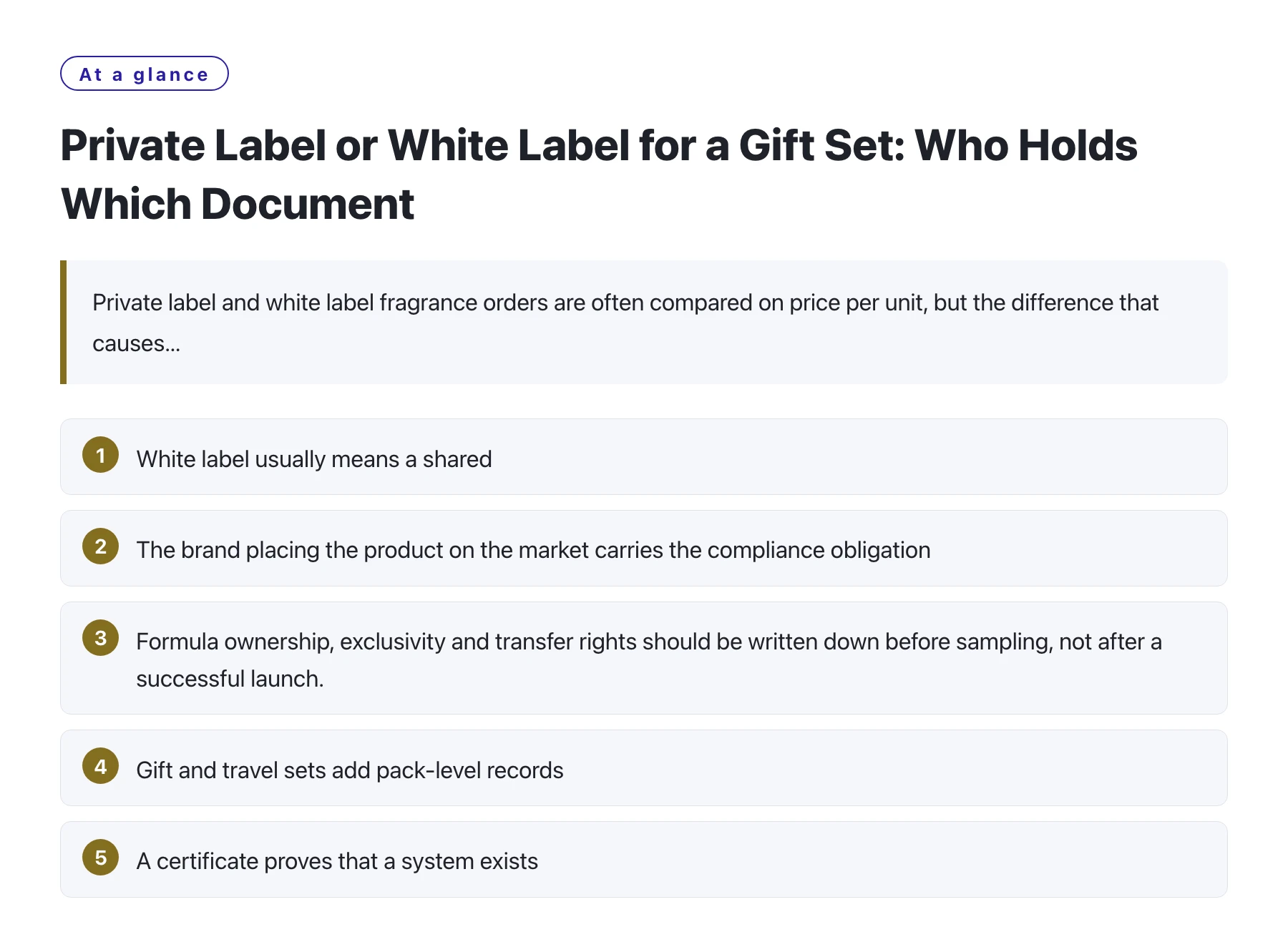
- White label usually means a shared, pre-developed product with your branding applied; private label usually means the product is made to your specification or on your brief.
- The brand placing the product on the market carries the compliance obligation, so it needs the technical documents even when the factory generated them.
- Formula ownership, exclusivity and transfer rights should be written down before sampling, not after a successful launch.
- Gift and travel sets add pack-level records, because the container, decoration and secondary packaging each carry their own specification.
- A certificate proves that a system exists; it does not prove that your order was produced under it, so ask for records tied to the batch.
Buyers new to fragrance manufacturing often treat private label and white label as synonyms with different price tags. In practice the two routes allocate ownership differently, and ownership is what determines what you can do with the product in year two: reorder it, move it to another factory, or sell the brand.
This is a document map rather than a legal opinion. It sets out which records matter, which route tends to hold them, and how a gift or travel set adds components to the file that a single bottle does not.
The ownership question behind the two labels
White label is built on a product that already exists. The manufacturer has developed the scent, may have an existing pack, and sells the same or a very similar item to more than one customer. The brand adds its name, its artwork and its market position. That is an efficient way to launch when speed matters more than exclusivity.
Private label is built on a specification. The product may be developed for the brand, or adapted substantially from a platform, but the arrangement is understood to be for that brand. In practice the two routes overlap, and the commercial agreement matters more than the label used in the sales conversation.
Either way, intellectual property questions belong in the contract. Trade secret protection, assignment of rights and the scope of any licence are the parts that decide whether the brand can take the formula elsewhere later [1]. A buyer who does not ask for that clause is buying a product, not an asset.
What the brand must hold regardless of route
Compliance responsibility follows the product as placed on the market and rests with the brand selling it, which in the EU includes appointing a responsible person established in the Union [2]. That responsibility does not move to the factory because the factory made the goods.
In practice this means the brand needs the safety assessment, the product information file, the formula specification and the labelling content, even when the manufacturer produced some of those documents. Holding them is not bureaucracy; it is what allows a reformulation, a market extension or a supplier change to be handled without starting over.
Where white label changes the file
With a white label product, the formula is likely to be shared, which usually means the manufacturer controls the specification and the brand receives a summary rather than a full recipe. That is normal and workable, but it limits what the brand can do later, including transferring production.
The practical test is a question: if this product succeeds and I want a variation in two years, who decides whether it is possible? In a white label arrangement the answer is often the manufacturer, and knowing that in advance is better than discovering it during a growth plan. The same test explains why brands with a long product plan tend to look for a factory for your own perfume label rather than for the shortest route to a first shipment.
Document map for a gift or travel order
| Document | Private label | White label | Who should hold it |
|---|---|---|---|
| Formula specification | Written for the brand or adapted from a platform | Shared platform specification | Both, in the form agreed in the contract |
| Safety assessment and product file | Commissioned or supplied for the brand's product | Supplied on the basis of the shared product | The brand, always |
| Allergen and labelling content | Produced for the specific formula | Produced for the platform formula | The brand, checked against each pack |
| Manufacturing certificate | Held by the factory, referenced in the file | Held by the factory, referenced in the file | The brand keeps a copy with the batch reference |
| Pack and decoration specification | Brand-owned drawings and artwork | Platform pack, brand artwork | The brand holds approved artwork and sign-off |
| Batch records | Generated per order | Generated per order | The brand should be able to request them |
The pattern in the last column is deliberate. Whatever the route, the brand ends up holding the assembled file, because the brand is the party that will be asked about the product after it is on a shelf. The factory's role is to supply the technical inputs and to keep production records that can be traced back to them.
How to build the file without drama
- Agree the document list at quotation stagePut the list in writing before the order is placed, so that nothing is described as an extra later. A document requested after shipping is a favour; before shipping it is a term.
- Tie every certificate to your batchAsk for records that reference the production of your order, not only the standing certificates of the factory.
- Review allergen and labelling content per packDeclaration requirements follow the finished product, so each pack in a gift or travel set should be checked rather than assumed to match the others [3].
- Confirm what the destination market requiresRules differ by country. Canada, for example, requires cosmetic products to be notified to Health Canada and to comply with the Cosmetic Ingredient Hotlist [4].
- Store the file with the reference sampleA signed reference standard kept beside the approved documentation is what makes a repeat order a comparison instead of a new project.
How a gift set adds documents
A single bottle raises mostly formula questions. A set raises pack questions, because every component in it has a specification: the container, the closure, the decoration, the insert, the outer box and, in a travel format, the smaller spray unit. Each one can change on a reorder and each one can affect how the product performs or how it is labelled.
That is why gift and travel orders benefit from a simple component register. List every part, the supplier, the approved drawing or artwork version, and the date it was signed off. When a repeat order arrives with a subtly different cap, the register is what turns a dispute into a check.
Who signs the artwork
In both routes, artwork approval should sit with the brand and be recorded by version. A manufacturer that adjusts a label file without a written approval creates a compliance risk that the brand inherits.
Ask who is responsible for checking that the approved artwork meets the labelling requirements of the destination market. If the answer is that nobody checks, that gap is worth closing before the first print run.
Where the paperwork is produced
Most of the technical inputs come from the manufacturing side, which is why the choice of partner shapes the quality of the file. A factory used to export orders will normally have a document pack ready to share, and its background and certifications can be checked against the records rather than accepted on a slide.
Where a project involves several suppliers, such as a fragrance house, a filler and a packaging printer, the brand becomes the assembler of the file. In that case, decide early who collects the documents, because a gap between two suppliers is the most common place for a missing record.
Buyers ordering in China often consolidate these steps with one partner to avoid that gap. Where a supplier offers their OEM/ODM manufacturing services together with filling and packing, the document list can be requested as a single package, which is easier to audit than four separate replies.
It also helps to know who the manufacturing entity actually is before the contract is signed, particularly when the sales contact, the filler and the brand owner are three different companies. contract perfume manufacturing in China can take several legal forms, and the paperwork follows the entity that produces the goods.
A short test before you commit
Ask the supplier to send the document list for one recent gift set order, with the format of each document. The goal is not to see confidential client data; it is to see whether the list is complete, how the records are organised, and whether the supplier can produce them without a week of internal chasing.
The reply is a decent predictor of what the same process will feel like during your own production run, when the pressure to answer quickly will be higher.
Two clauses are worth more than a discount in this part of the negotiation. The first states who owns the formula, the artwork and any tooling. The second lists the documents that must be handed over at shipment. Both can be agreed in a page, and both are much harder to obtain after the product has launched successfully.
Sources
- WIPO — World Intellectual Property Organization —— The UN agency for intellectual property; resources on industrial design and patent protection relevant to product and packaging design.
- European Commission: Cosmetics in the EU —— The European Commission's overview of EU cosmetics rules, including the responsible person, product information file and safety report requirements.
- EU Scientific Committee on Consumer Safety (SCCS) —— The EU scientific committee that issues opinions on the safety of cosmetic ingredients, including fragrance allergens and their labelling thresholds.
- Health Canada: Cosmetic Safety —— Health Canada's cosmetics pages, covering cosmetic notification, the ingredient hotlist and safety requirements for cosmetics sold in Canada.
Frequently asked questions
Is white label cheaper than private label?
Usually, because development work and tooling are shared across customers. The saving comes with less exclusivity and, often, less documentation that travels with the brand. Compare the two routes on total cost including what you would pay to reproduce the product elsewhere.
Do I need a product information file if the factory made the scent?
The obligation to hold the file generally sits with the party placing the product on the market. The factory supplies technical inputs, but the brand remains responsible for having the complete file available, so the two roles should be written into the contract.
What is the most commonly missing document?
Records that tie a certificate or test to the specific batch supplied. Standing certificates are easy to share; batch-level records require a system. Ask for both and note which one arrives promptly.
Can I move a white label product to another factory later?
Only if the agreement allows it and the documentation is transferable. In many white label arrangements the formula stays with the original manufacturer, so the brand would need to develop a new product rather than move the existing one.
Does a gift set need separate documents from a single bottle?
The formula documents are the same, but the pack adds specifications for each component, including decoration and any travel unit. Keep a component register with approved versions so repeat orders can be checked against it.